


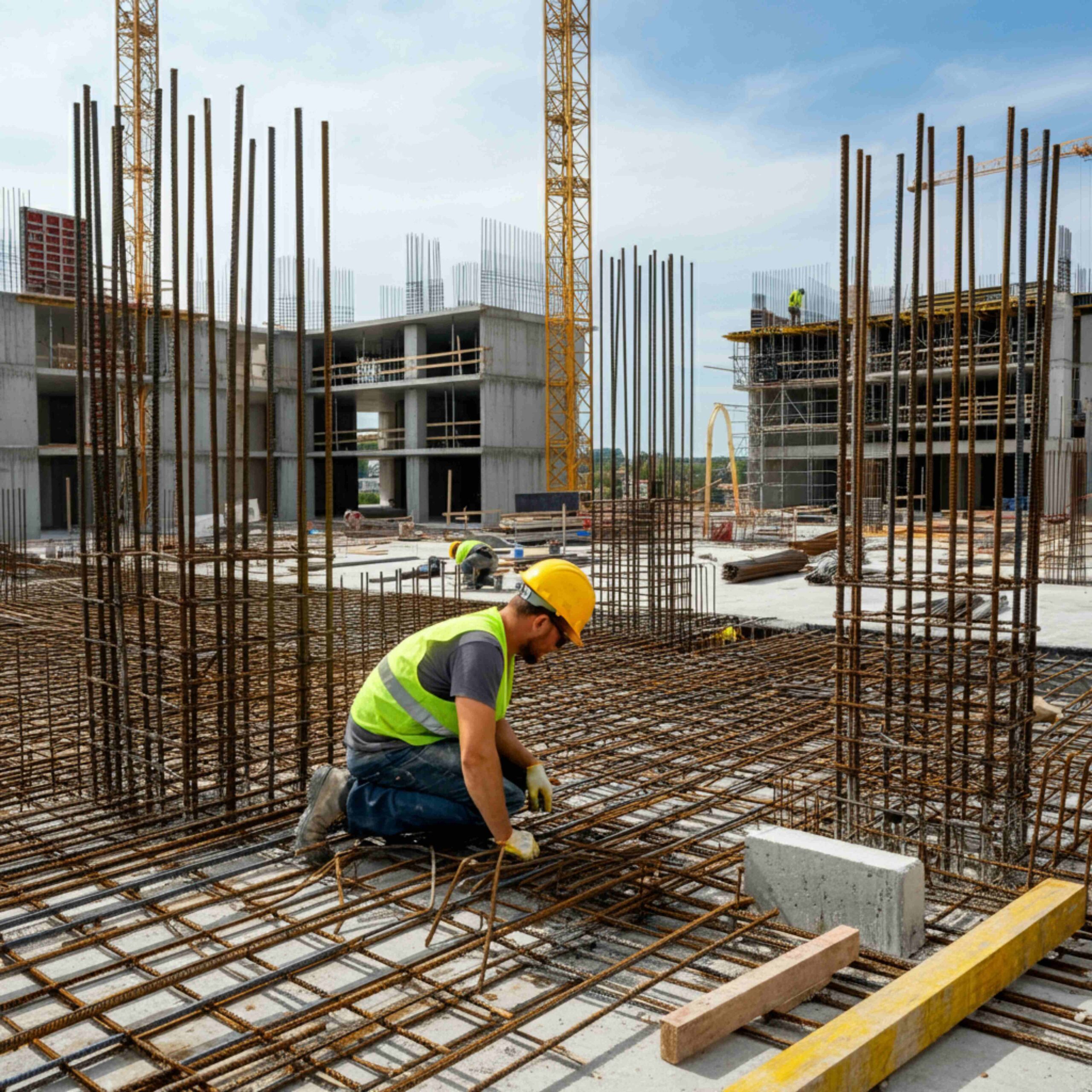
Structural works are the most critical phase of any construction project, as they determine the strength of the building and its long-term durability for decades. Although many details of this stage are not directly visible to the owner, their impact is the greatest when it comes to construction quality and the potential problems that may appear later.
Proper execution begins with soil investigation and selecting the appropriate foundation system, followed by verifying groundwater levels and the quality of materials used. It also includes precise control of excavation works and structural concrete casting. In addition, implementing waterproofing and thermal insulation in compliance with the Saudi Building Code is a fundamental step, as any weakness at this stage later turns into costly and difficult-to-resolve issues.
However, the most decisive factor—the one that truly makes the difference—is execution quality and supervision. A professional contractor does not simply carry out tasks; they adhere to precise measurements, proper concrete curing, and strict compliance with drawings and specifications. In contrast, traditional or unstructured execution often leads to defects that do not appear immediately, such as cracks, leakages, or soil settlement.
Another essential element that many owners overlook is integrated coordination among all parties involved in the project. Successful structural works depend on harmony between suppliers, labor teams, technical crews, and site management, all operating under a clear work plan and an organized timeline. This coordination reduces conflicts, prevents work overlap, minimizes waste, controls costs, and ensures on-time project delivery without delays.
Behind the scenes, precise processes take place, including material testing, level measurements, concrete curing, and verification of compliance between execution and design drawings. While these steps may go unnoticed by the owner, they are the key difference between a building that lasts for decades and one that requires continuous maintenance spending.
Understanding these fundamentals empowers owners to better evaluate construction quality and play an active role in protecting their investment—ensuring a project that achieves the highest levels of durability and sustainability.
Amvic’s SilveRbord
The partnership is underscored by PCL and STACK’s commitment to innovation in the construction industry. After a rigorous evaluation of the market and multiple competitor software solutions, PCL chose STACK based on the platform’s data availability, cloud collaboration, data security, and integration capabilities.
To integrate the entire building lifecycle into a seamless platform to redefine how the world builds. Vel altera malorum ei. Eam at erat dicat vocent, vel et magna vitae principes, et sea dicit eripuit.
Barbra Streisand
By leveraging STACK’s open API, PCL is able to seamlessly integrate their existing workflow to produce better estimating data. Through the cloud-based platform, PCL will have unparalleled flexibility and accessible data, increasing the precision of estimates, minimizing manual processes.
The Advantages of Panalized Systems
A key decision criterion for PCL was based on the fact that STACK is built on a modern cloud technology platform which enables improved collaboration during the quantity takeoff process.

PCL is a powerhouse, consistently in Engineering News-Record’s Top 15 List and boasting a range of projects from San Diego Airport’s International Arrivals Terminal to Major League Soccer’s Los Angeles-based BMO stadium. The partnership between PCL and STACK marks the beginning of an exciting chapter for two of the most innovative companies in construction.